
If your offshore team isn’t delivering at the level you expected, there’s a high chance they’re missing one crucial ingredient: structured offshore team training.
This isn’t unique to offshore teams. Even within Australia, almost 60% of employers say skill gaps are already affecting productivity according to AHRI’s 2024 report. The same applies to offshore teams who operate with less context, less visibility and fewer opportunities for organic, on-the-spot learning.
For offshore staff to perform at their best, they need capability building for remote teams, not just onboarding.
Not just instructions.
Not just tasks.
But ongoing development, cultural integration and clarity.
Offshore teams are not “plug-and-play” – they need context, clarity and capability.
Offshore team members, whether in the Philippines or elsewhere, face natural barriers that can impact offshore staff performance:
Less environmental context.
Fewer real-time clarifications.
Different cultural norms.
Reduced workflow visibility.
No proximity-based learning.
When these gaps aren’t addressed, leaders see more rework, slower turnaround times and decreased initiative.
Offshore teams are not virtual assistants – they can do far more if developed.
Calling offshore talent “virtual assistants” dramatically undersells their potential. While offshore teams were once associated mainly with call centres, the landscape has changed significantly. Modern offshore teams now support a wide spectrum of specialist and technical roles across diverse industries.
Most Access Offshoring placements are:
These are capability-builders, not task-takers. They can own outcomes, make decisions and improve processes but only if trained not just in tasks, but in how your business works.
To maximise ROI, strengthen offshore staff performance through training.
Businesses often offload tasks offshore for capacity or cost savings. But the real ROI emerges when remote teams can:
Solve problems independently.
Suggest process improvements.
Manage complexity.
Understand priorities deeply.
Communicate with confidence.
Own outcomes fully.
Training accelerates this transformation. National analysis by CEDA (2024) shows that employees who take up work-related training see incomes jump by ~20% the following year and become more productive and less likely to leave. For employers, CEDA is blunt: ramping up training is essential to lift weak productivity growth.
Training builds confidence. Confidence breeds competence.
The biggest barrier for offshore staff is rarely skill – it’s confidence.
Confidence to:
Ask questions.
Clarify context.
Suggest improvements.
Lead processes.
Training removes uncertainty and empowers offshore staff to operate as true team members, not order-takers. With confidence comes higher quality, faster delivery and greater accountability.
Fully integrated offshore teams perform better and training drives that integration
Offshore teams perform at their best when they feel connected, informed and aligned with their Australian colleagues.
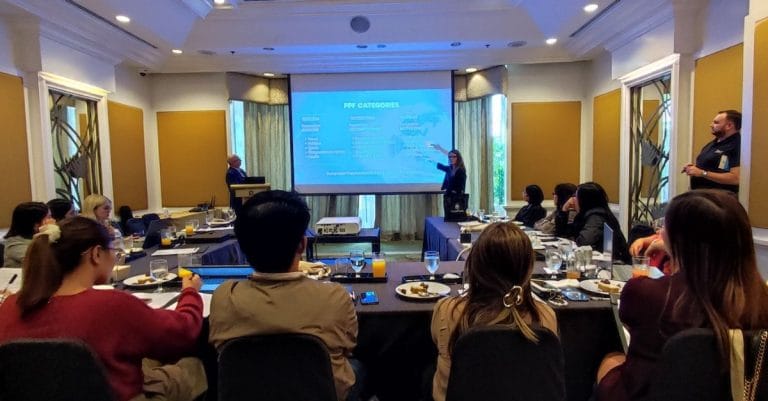
Training bridges the distance. Many of our clients travel to the Philippines at least twice a year for team workshops, process reviews and capability-building sessions. The results:
Deeper trust.
Faster communication.
Less rework.
Shared culture.
Stronger retention.
Real business momentum.
When offshore and onshore teams learn together, they perform together.
APOS™: The training most leaders don’t know they need but can’t scale without
Many leaders underestimate how cultural and communication friction affects offshore output. APOS™ (AU-PH Operating System) addresses this.
It equips offshore and onshore teams to work the Australian way:
Clarity over hierarchy.
Initiative over waiting.
Context-rich communication.
Transparency and directness.
Shared expectations on deadlines.
Collaboration over deference.
For many clients, APOS™ is the missing link that turns an offshore hire into a true extension of the business, boosting retention, productivity, autonomy, and team relationships while reducing management fatigue.
The businesses winning with offshoring all do one thing: team training
Successful businesses don’t just hire offshore talent. They develop it. They understand the simple truth that training is not a cost; it’s a multiplier.
When you train your offshore team, you get the full value of offshoring, not just cheaper labour. Remote teams are capable, ambitious and can drive significant impact but only if trained, integrated and empowered.
Your onshore teams also need the CQ training to collaborate effectively across borders. When both sides understand each other’s context, working styles and expectations, productivity and trust increase dramatically.
Structured programs like APOS™ and ongoing capability-building initiatives ensure offshore teams operate at the same level as onshore staff – while also equipping onshore teams to lead, support and engage their offshore colleagues effectively. Learn more about APOS™ here.