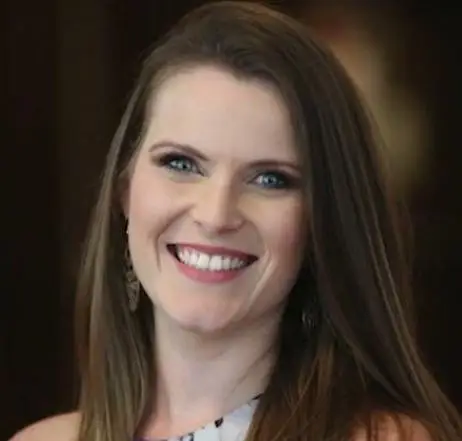
A write-up from Tiffany English, CEO of Access Offshoring, adapted from her AFR BOSS Young Executives 2026 award entry.
There’s a question I get asked constantly by Australian business leaders exploring offshore staffing: “How do you maintain culture when your team is in another country?”
It’s the wrong question. And the answer is hidden inside it.
Organisational culture has never been about location. It’s about shared purpose, consistent standards, and how people feel about the work they’re doing every single day. The reason so many offshore staffing arrangements fail – and the failure rate across the industry sits around 70% – isn’t geography. It’s a transactional mindset that treats global professionals as a cost line rather than colleagues.
At Access Offshoring, we made a deliberate decision from day one to build differently.
What we built instead of a headcount
When we first launched, I watched the same failure pattern play out again and again. Australian businesses would bring on offshore staff to cut costs, provide minimal onboarding, then call it a failed experiment when their team left within months. The problem was never the people. It was the design.
So we took the opposite approach. Every person who joins our global team goes through APOS – our proprietary onboarding and people management platform, built to close the cultural, communication and professional gap between Australian and Filipino workforces. It’s not a welcome kit. It’s a fully integrated system that uses predictive matching and structured communication frameworks to create genuine alignment before day one, and to keep that alignment strong for the life of the contract.
The results speak for themselves:
Our staff stability rate sits at three times the industry average.
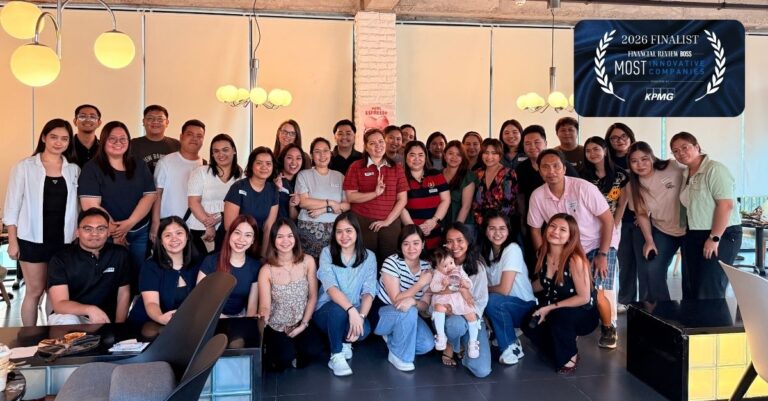
We scaled from 30 to more than 430 professionals in just a few years.
Every leader who helped build this company is still here today.
That isn’t a coincidence. It’s a design outcome – and it’s the same outcome any business can achieve with the right offshore staffing model.
Remote culture is built, not inherited
Being an official entrant in the AFR BOSS Young Executives of 2026 is something I’m proud of. But what I’m more proud of is what that recognition reflects: a team, a system, and a set of standards that work because we refused to take shortcuts.
Global teams don’t drift apart because of time zones. They drift apart because the systems holding them together were never built in the first place. If your remote culture feels fragile, that’s a design problem – and design problems have solutions.
Three things have made the biggest difference for us:
1. Onboard for connection, not just compliance
Most organisations onboard for compliance. We onboard for belonging – before day one, not after. There’s a significant difference in what people feel in their first week, and it shows up directly in whether they’re still with you at the one-year mark.
2. Close cultural gaps before they open
Cultural misalignment doesn’t announce itself. It accumulates quietly – in missed cues, unspoken expectations, and assumptions on both sides. Building communication frameworks that surface and address these gaps early is non-negotiable for offshore team retention.
3. Build a leadership model that runs on systems, not on one person
Scalable culture requires that values and standards live in process, not in a single individual. When your culture can only function because one specific leader is in the room – or on the call – that isn’t a culture. It’s a dependency.
The shift leaders need to make
If your global team feels like a “them” rather than an “us,” that’s a design problem. And it’s entirely fixable.
Organisational culture travels when you build it to travel. It doesn’t require a shared office. It requires shared purpose, shared standards, and an environment where every person – regardless of where they’re sitting – knows their contribution matters and their growth is invested in.
Leadership retention and team retention are downstream of the same thing: whether people feel like they belong to something worth staying for.
Culture isn’t spontaneous. It’s built. And when you build it with intention, it doesn’t care about time zones.
Access Offshoring helps Australian businesses build integrated global teams that stay. Visit accessoffshoring.com.au to find out more.